

An Affinity for Mortals
in which I explore some Greek mythology; some up- and downsides of tragedy and comedy; and, of course, a new word

I have a new word for you.
Well, it’s a new word for me, anyway, and I’m a little bit thrilled about it because it’s a simple word with a simple meaning, and yet I’ve never heard it before.
What is it? you’re wondering, or I hope you’re wondering. Otherwise, why go on?
Quickly now: the word is ludic.
There, I’ve told you. Now you must answer me in the comments below: Do you already know this word?
You silent reader, you. I know you’re eager (of course you’re eager) to know, but I’m left to wonder which you want to know first: the word’s meaning or where I found it?

I found it here, in a review of the novel Orbital:
Bill Anders’s “Earthrise” picture, taken on the Apollo 8 moon mission, in 1968, presented the Earth, for the first time, as we see the moon: gibbous, squashed, half shrouded in darkness, and almost ponderously ludic, as if playing sluggish peekaboo.
Looking at that photo, reading Wood’s words, can you guess what “ludic” means?
“Peekaboo” is your best hint: ludic means playful.
The synonyms for ludic are many. Many.
Here are some: comical, hilarious, droll, humorous, jocular. These make sense to me in the context of the word’s primary definition, because playful— to me— is joyous and innocent, constitutionally positive.
But synonyms tell rich stories, providing dimension one might not realize or, indeed, anticipate. Such is the case for me with ludic, which is defined as above but is also synonymous with brainless, daft, puerile, insane, and asinine.
Alas, so pejorative!
And also I get it: the playful can trend this way. I’ve seen it happen. Lots.
But still, my introduction to ludic started so well. When I think of playful, I simply don’t think (at all) of behavior trending toward weak-minded, half-witted, or mad. Do you?
Of course, depending on how you connect words to others in your brain, ludic may immediately bring ludicrous to mind. And ludicrous does indeed mean half-witted.
Interestingly, ludicrous’s first meaning is funny (causing or intending to cause laughter); but in my experience, it’s more commonly used for its second meaning, which is ridiculous:
After Steve’s ludicrous tantrum over the tofu, I hardly wanted to take a risk with him at the Ethiopian restaurant.
We have no problem with the connection between ridiculous and ridicule. These clearly go together: we ridicule that which is ridiculous. But ludic — I mean playful— need not entail the scorn inherent in ludicrous, right?
I find it a little sad. As I said, on meeting ludic I had no idea of its irrevocable tie to farce.

In ninth grade I found myself in honors English, a surprising development as I was innocent of academic ambition at the time. I had no idea what I was in for.
In that academic year, we read and discussed as a class three full Shakespeare plays (this one, this one, and this one), a passel of short stories (including this one), and maybe three to five full novels (unforgettably this one and this one). We also had a nasty little project going known as “supplemental reading,” for which we had to select from a list one novel a month, read it in full, and then— without any notes or discussion— respond to it via a written essay in class. And no, we weren’t given the essay question beforehand.
Never mind what students appear capable of in terms of reading nowadays. The coursework in that 9th grade honors English class was vigorous.
Also, almost without exception, the literature we read was sad.
The only lighthearted text I recall from that year was A Midsummer Night’s Dream. And in places, To Kill a Mockingbird made me laugh out loud. Everything else was ponderous and heavy. Tragic.
This got to me.
I continued with honors English throughout my high school career, but I was wary. At the beginning of year two, I pulled my new teacher aside and asked, Why was everything we read last year so sad? And should I be expecting more of the same?
Funny the things I remember. We were standing outside her door just before the start of class. Behind her, morning sunlight filled her classroom through windows that looked into a begardened courtyard. I didn’t yet know it, but over the coming months she was to introduce me to Greek mythology, which I would love. We would read The Iliad, Julius Caesar, and El Cid. I would give a very bad speech. And we would embark on a vocabulary study that would terrify me, prepare me for the SAT, and refine in me a love of words that would shape ways in which I see the world.
She explained: We read tragedies because the tragic takes the human condition seriously, whereas the comic simply doesn’t.
Fair enough.
Who doesn’t love a good comedy though, am I right? In the heaviness of this world we need to laugh. And laughter is good for you: it increases blood-flow, protects your heart, and relaxes your muscles. It also releases things like seratonin, which boosts your mood. And shared laughter connects us to others.
It’s healthy, too, to laugh at ourselves, to confront our shortcomings as humorous so we can rise to overcome them or at least realize they’re not tragic flaws ushering us to an unavoidable doom.
I have a dear friend who with her husband always watches an episode of a sitcom just before going to bed. Bill and I also have a set of favorites we love to turn to (here are some of them). Sometimes we’ll pick one out intentionally after a heavy day or a particularly unhappy documentary as a kind of catharsis.
It works.
But there’s a danger in humor if we find ourselves always and only looking for the comic. It can slide so quickly from ludic to ludicrous, from finding the bright side to seeing everything as a joke.
Years ago I saw a new TV comedy advertised that I knew we’d love. I was kind of proud for having discovered it, as it’s usually my husband or children who introduce new delights from popular culture.
I wasn’t wrong: the sitcom has a strong set of hilarious characters, and the writing develops their various, self-inflicted problems in brilliant ways. But I stopped watching it a long time ago. Why?
To a person, the characters are only comic fools. There’s no goodness among them, no strength, nothing to root for. The plot always and only serves to lampoon their idiocy, which ultimately leaves me feeling a little hopeless. The show is 30 minutes of well-written, amusing contempt— and I can do without contempt, thank you very much.
contempt. 1a: a feeling of intense dislike for someone or something regarded as unworthy of respect or approval : disdain.
I’ve wondered from time to time what makes a thing truly funny. Philosophically, I mean. How do we define humor? I’m sure there are studies on this.
In considering it, I’ve actually questioned what God finds funny— for certainly he has a sense of humor. One could (one should) argue, in fact, that he has the very best sense of humor. That he invented humor itself.
I’d like to pursue this curiosity at some point, but let’s make this distinction here: surely humor is more pure when one is laughing with someone rather than laughing at them. Because there’s something about laughing at someone that minimizes their plight— that could, if we’re not careful, belittle them. That finds us— sometimes, anyway— viewing them with contempt.
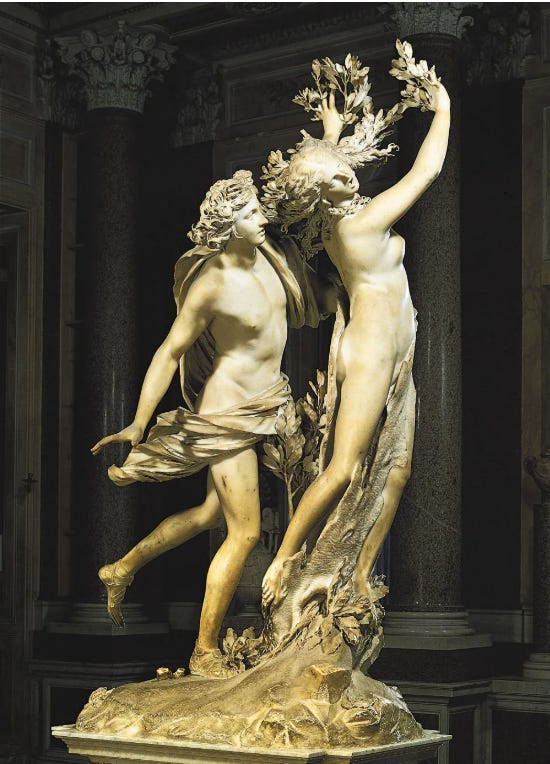
Of the Greek myths we studied in 10th grade, the story of Apollo and Daphne was my favorite.
It begins with a tease: the god Apollo, archery master that he was, laughed at Eros because of his tiny little bow. But Eros, who happened to be the god of love, doesn’t see the humor. When Apollo is looking the other way, Eros shoots him with one of his arrows, making the god fall in love with a nymph named Daphne.
This is the love god’s M.O., as is revenge, when necessary: he shoots Daphne with an arrow that makes her hate love. By the rules of Greek mythology, the relationship is doomed.
Apollo pursues her and she flees, but a nymph is no match for a god. As he gains on her, Daphne cries out in terror to her father Peneus, god of the river. Just as Apollo reaches her, Peneus transforms his desperate daughter into a laurel tree.
It’s a simple origin story: Apollo can’t be united to his love, but he gestures toward granting her eternal life by transforming the laurel into an evergreen. And in most ancient representations of the god, you’ll see that he wears a crown of laurel leaves.
Famously, the laurel wreath itself went on to symbolize power and achievement (think crowns in the Roman empire), but Apollo famously wore it to honor Daphne. It’s a reminder of his love for her, but it must also remind him that his jest was foolish, as it cost Daphne her life.
I liked that story because of Apollo’s vulnerability, an uncommon trait among on Olympians. Most of the time, the divine wield their power over humans in ruthless self-absorption.
Sure, you can find your exceptions. But even Athena had an ulterior motive in aiding Odysseus. She definitely had an affinity for him, what with all his clever craftiness, so like Athena herself. But don’t forget she had it in for Poseidon at the time. Helping Odysseus was a way for her to exact some punishment on her uncle.
Most of the time, Athena is as selfish and vengeful as the rest of the Olympians. Just ask Arachne.

You can’t argue that this little missive is anti-humor. Remember that I started with a love for ludic’s primary definition. Laughter is one of the best things we’ve got going, I’m convinced of it.
The problem I have is with scorn. Derision. A posture that belittles. These have so much to do with turning a blind eye to the beautiful, to subsisting on half-truths. To holding the world at ironic lengths.
What I mean to say is that there’s danger in it.
Remember the description of the moon I quoted above? It’s part of a review of Samantha Harvey’s Orbital. The novel is a fictional account of twenty-four hours aboard the space station, told through the experience of six astronauts. As these scientists go about their daily tasks, they view Earth out the station’s windows: seas and oceans, continents and cloud formations over the course of one day.
Harvey writes that the Earth
harbours we humans who polish the ever-larger lenses of our telescopes that tell us how ever-smaller we are. And we stand there gaping. And in time we come to see that not only are we on the sidelines of the universe but that it’s of a universe of sidelines, that there is no centre, just a giddy mass of waltzing things, and that perhaps the entirety of our understanding consists of an elaborate and ever-evolving knowledge of our own extraneousness, a bashing away of mankind’s ego by the instruments of scientific enquiry until it is, that ego, a shattered edifice that lets light through.
This novel sings Earth’s singularity and assents to its insignificance.
And I do think it’s natural, upon seeing something so vast, so apparently limitless as our universe, to feel small. But does knowing that smallness also make us extraneous? That’s a lesson extended from the wrong gods, a heritage of our own mythologies. It’s a tale told by Zeus and Tiamat, by Lamech and Gilgamesh and, more recently, Nietzsche and our interpretations of Darwin. What have we learned?
That next to power, weakness is ludicrous, insignificant. Contemptible.
Harvey is right: the light is coming through. But we need to change our view: let’s let the ever-expanding understanding of our universe not tell us first about ourselves. Rather, let it tell us first about the One who made it: that he must be vastly greater, wiser, more powerful than we have yet conceived.
And then let us consider what he’s done, what he does for us. What if, contrary to all our expectations, this outrageously powerful being doesn’t demean or even ignore us? Recall that in truth he loves us, that he is Love itself. That sidelined though we may be within this “giddy mass of waltzing things,” God nonetheless became one of us, condescended to live here, bled and died for us. Rose from the dead. Prays for us. Knows us. Calls us to himself.
He has an affinity for mortals, not contingent on what we are but very much based in who he is. In which case we’re not so belittled after all. We’re not held in contempt. In fact, our circumstance is very much the opposite.
Psalm 8
Lord, our Lord,
how majestic is your name in all the earth!You have set your glory
in the heavens.
Through the praise of children and infants
you have established a stronghold against your enemies,
to silence the foe and the avenger.
When I consider your heavens,
the work of your fingers,
the moon and the stars,
which you have set in place,
what is mankind that you are mindful of them,
human beings that you care for them?You have made them a little lower than the angels
and crowned them with glory and honor.
You made them rulers over the works of your hands;
you put everything under their feet:
all flocks and herds,
and the animals of the wild,
the birds in the sky,
and the fish in the sea,
all that swim the paths of the seas.Lord, our Lord,
how majestic is your name in all the earth!
All right now. Did you know ludic before you read this? Tell me. And have you read Orbital? If not, get to it. You’re in for a treat.
Meanwhile, thanks so much for being here. I continue to be amazed by it. Amazed and grateful.
With joy,
Rebecca
And This One…. Says thank you.
Love learning new words with you! Thanks for the book recommendation, too - Orbital sounds fantastic!