

The stone is rolled back
:: April 2023 :: my news from an Easter near you ::

“Greater love has no one than this: to lay down one’s life for one’s friends.”
~the words of Jesus, John 15.13
Dear Friends,
I’m writing to you in the early days of Eastertide, which I’ve recently learned is something we can say but generally don’t. Still, I like saying things in new ways and so I’m saying this (“Eastertide”), as it refers to the current period in the Church calendar in which we observe and celebrate the ongoing reality of Jesus’ resurrection from the dead.
I wasn’t reared in a church setting that paid great attention to the traditional Church calendar, so I’m enjoying learning about it. Having attended the University of St. Andrews last year, I learned what is meant by the terms “Michelmas” and “Candlemas,” which have constructions (I’m guessing you see it) similar to “Christmas.” Many have heard of the period known as Lent, which comprises the 40 days between Ash Wednesday and Holy (or Maundy) Thursday. And then there’s Holy Week, which comprises the days between Palm Sunday and Easter. But now I’m learning that we’re still *in* Easter (hence “Eastertide”), because Easter actually comprises a seven-week period, starting Easter Sunday, that culminates in Pentecost.
I’m challenged at the thought of intentionally observing Easter for seven weeks, but it’s likely worth the effort. Jesus rose from the dead. There’s matchless beauty there, certainly enough to ponder for 49 days.
A friend closed an email to me the other day with these words: “Happy Eastertide! What a wonder.”
And it is.

Words, words, words
I have more to say about Easter and the death and resurrection of Christ, but first this: Did you notice that I used the word “comprise” three times in the second paragraph (above)? Go look. I’ll wait.
See?
You may recall that recently I asked you for your understanding as to the correct definition of “comprise,” and this because a reader had critiqued my use of the word in a previous newsletter. Friends, your response was stellar. Truly. I got so many replies (thank you!), and you know how I love that.
All of my respondents got the definition right. Because of course they did.
About half of them went on to use the word by saying that something or other was “comprised of” such and so. Here’s an example provided by E: “The meal was comprised of a chilled appetizer, a cold salad, a palate-cleansing frozen sorbet, a lukewarm main course, and a heated debate about whipped cream.”
(Before you do anything else, please just appreciate the clever assortment of temperatures in that sentence.)
Note that its writer (and, again, about half of the respondents) used “comprise” in this way, which is to say that the word means to compose or constitute. In this usage (although not necessarily every time), the word often appears as follows: “comprised of.”
This is how I used it (offensively) in a previous newsletter, to which my reader responded (and I quote), “I still cringe when I hear that.”
Why? Because the definition that results in the usage “comprised of” is the word’s second and younger definition. Many see this usage as incorrect.
My cringing reader prefers the word’s first and more traditional definition, which is to be made up of. This definition makes for sentences like you read in my second paragraph (above) and in this sentence from K: “Sending every. single. response. to this present word prompt would comprise a sweet comeuppance to the editorial purist who corrected you in the first place.”
(Perhaps you recall that I threatened to send all of your responses to the one who critiqued me? I didn’t do it.)
Here’s the thing: both definitions are correct. Both usages are correct. And my critic (the editorial purist) recognizes this. He went on to acknowledge, “Of course, language grows and evolves, and meaning is ultimately use, but still….” He’s not alone in his cringing. In fact, Merriam-Webster has a little usage guide about the the words “comprise” and “compose” because, well, the confusion we’re tracking is an issue.
But we all have them, don’t we? Word usages that set our teeth on edge, I mean. Words that can make us cringe.
So I guess you can guess what’s coming. In response to this newsletter, please share a word whose use (incorrect or otherwise) drives you a little bit crazy.
(I’m so excited about this one!)
“…walk in the way of love, just as Christ loved us and gave himself up for us as a fragrant offering and sacrifice to God.”
~Paul the Apostle, in his letter to the Ephesians, 5.2
Some News
I am absolutely going to get back to thoughts on Eastertide, but first I must share these things (this is a newsletter, after all).
I’m returning to full-time teaching! In a newsletter six months ago, I told you I was planning to pursue a PhD in theology, but after much reflection, I decided that I wanted to focus more on writing. Then a few days later, I stumbled upon a job description here, where I taught humanities years ago when my children were young. I’m delighted and grateful to be returning to the classroom, and I’m excited to be working with others at the school to build a more robust theology program for the high school students there. If you’re the praying kind, you can pray with me that I’ll be a blessing to my students, their families, and my colleagues. I’ll be writing curricula this summer and begin teaching in August.
At the end of October, I’m going to be speaking at the annual Faithful Witness Apologetics Conference at Palm Beach Atlantic University in West Palm Beach. I’m honored to have been invited, and I’m excited by the topic: imagination, creativity, and apologetics.
My invitation came from Paul Gould, whose work with the Two Tasks Institute I’ve been following for some time. I read his Cultural Apologetics in 2019 and was taken with his vision for Christ-followers to bring the truth and beauty of Jesus to our disenchanted world. I highly recommend it. My copy is dog-eared, underlined, and full of marginalia, so you’ll need to get your own.
The other day Google maps sent an interesting bit of memorabilia my way: details of a trip to Grove City College six years ago. GCC is my alma mater, and back then my novel Healing Maddie Brees was a new release. In April 2017 the school hosted me for two talks: one on imagination and the other on the novel itself. I enjoyed the visit immensely, especially because of two of my former professors who had taught me much about literature and fostered my love for writing. It was so kind of them to attend.
I continue work on an essay about victimhood and the Church, which has been slow-going for several reasons. Of course I’ll let you know if/when it gets published. Meanwhile, I also continue research for my next novel (working title Sharpsville Man Burns Christmas Trees) and a nonfiction book on joy in the work of Kierkegaard.
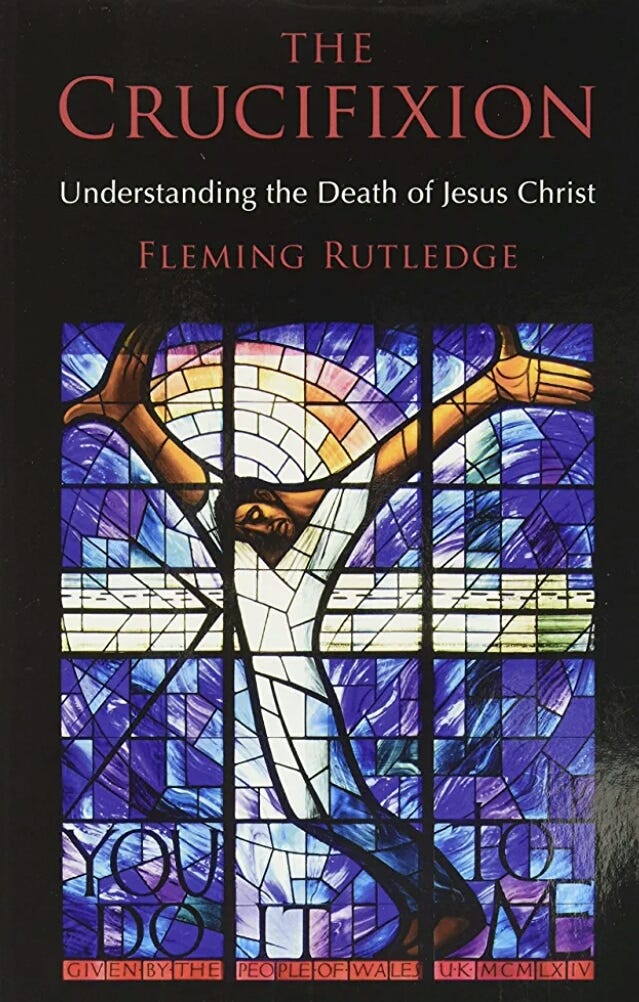
Finally, back to Eastertide.
I’ve been reading the above book for some time now. You may recall that my friend Jenny and I aimed to read through it during Lent. Neither of us quite made it (I have about 100 pages to go), but I’m so glad to be reading and learning from author and Anglican priest Fleming Rutledge.
She points out that we see crosses all the time. They feature in paintings, on church lawns, and as jewelry. By those lights, it’s easy for us to be inured to both its significance in the Christian faith and the way in which it was seen (and used) in ancient Rome.
But as human beings we have an uncanny knack for becoming accustomed to lots of things, which can inhibit our capacity for wonder. For example, we’re accustomed to the Easter narrative, the extraordinary claim that a man who was dead for three days was raised to life again and lives eternally.
This is why I appreciated the closing words of my friend’s email (“What a wonder”). And it’s one reason why I appreciated my pastor’s sermon on Sunday, in which he pointed out the unbelievable quality of Christ’s resurrection.
But here’s what Rutledge has to say about that, and it’s echoed by Oxford historian Tom Holland: “If Jesus had not been raised from the dead, we would never have heard of him” (31).
The Romans crucified people all the time. A carpenter crucified in the Judean outpost of the Empire was of absolutely no consequence. And yet many, many, many people the world over have heard of Jesus.

Rutledge continues: while the Romans certainly had many ways of killing people, death by crucifixion had the specific intent of dehumanizing the victim. Certainly the prolonged suffering was prized: victims of crucifixion often take many days to die. But the open display was important as “a form of advertisement, or public announcement— this person is the scum of the earth, not fit to live, more an insect than a human being. The crucified wretch was pinned up like a specimen. Crosses were not placed out in the open for convenience of sanitation, but for maximum public exposure” (92).
Again, crucifixion in the Roman Empire was commonplace. And many religions at the time featured humans who became or were gods. But a crucified god was unthinkable: no worthwhile god would suffer crucifixion in any narrative.
It’s the vile offense of the cross that propels Rutledge’s project. If asked why Jesus died, many of us would answer that he did so to show us God’s love. But why such a horrific and gruesome death? Why did he have to die in this way?
“A new command I give you: Love one another. As I have loved you, so you must love one another. By this everyone will know that you are my disciples, if you love one another.”
the words of Jesus, John 13.34-35
There’s so much more to say here about the crucifixion, about atonement, about the theology Rutledge explores and explicates in her book. I’m just going to write briefly on a reason for the appalling shame that Jesus suffered.
As mentioned above, I’m at work on an essay about victimhood and the Church, and one thing I’ve learned about victimhood is its dehumanizing nature. A victim who is victimized at the hands of another person (as opposed to the victim of a car accident or even a natural event) is a person who has been acted upon by another.
In other words, the victimizer has sought to minimize the humanity of their victim, exerting power over that person against their will. This is a terrible thing, as all persons are made in the image of God and therefore are worthy of honor, love, care, and respect— and that’s putting it lightly.
One way a victim can move toward healing is to have others see and acknowledge their suffering. In acknowledging the wrongness of what has been done to the victim, those others can help restore the victim’s sense of justice and safety.
Being crucified, Christ not only endured the worst physical anguish; he also suffered dehumanizing shame. As the resurrected Lord, he not only acknowledges the suffering of victims, but he experienced that suffering and degradation in his real, physical body.
But the crucified God-Man did more than this: he suffered not only to bring restoration to the victim, but also to the victimizer. He understands better than we do that when we degrade another person— a fellow bearer of God’s image— we hurt both that person and ourselves.
And he understands— far better than we do— that each one of us is capable of both: any of us who is a victim can also be a victimizer. Yes, I was a victim of middle-school bullying, but I’ve been a bully myself.
Of course there are degrees of victimhood, and I don’t want to paint with too broad a brush. But by the standards of scripture and the love Christ describes, we are all guilty of regarding one another, from time to time, as “less than.” We dehumanize each other with our criticism, our failure to listen and love.

Sometimes I think the cross offends people these days because it says that we’re in need of forgiveness. We think an understanding God shouldn’t be bothered by what we do wrong. He should be gracious and merciful and not be criticizing us all the time.
At the same, we’re all hungry for justice. We’re hard-wired, it seems to me, to want to protect people from harm— and when wrong has been done, we know that justice must be served: the offending person must be kept from doing further hurt; reparations must be made.
Should not God, then, also be just? In truth, the Creator of the world, Great Lover of all persons must do justice. As Mirsoslav Volf says, “A non-indignant God would be an accomplice in injustice, deception, and violence” (131).
The horror of the cross is its gruesome shame. The beauty of the cross is the God-Man who hung there. His death signals to us not his criticism, but his love. It tells us what on some level we already know: we’re all both victims and victimizers to some extent. We’re all in need of rescue from that cycle of unkindness and, sometimes, cruelty. He thinks we’re worthy of that rescue.
Through his shame and suffering— and his glorious resurrection—He’s the One who brings it.
"Seven Stanzas at Easter"

Make no mistake: if he rose at all
It was as His body;
If the cell's dissolution did not reverse, the molecule reknit,
The amino acids rekindle,
The Church will fall.

It was not as the flowers,
Each soft spring recurrent;
It was not as His Spirit in the mouths and fuddled eyes of the
Eleven apostles;
It was as His flesh; ours.

The same hinged thumbs and toes
The same valved heart
That--pierced--died, withered, paused, and then regathered
Out of enduring Might
New strength to enclose.

Let us not mock God with metaphor,
Analogy, sidestepping, transcendence,
Making of the event a parable, a sign painted in the faded
Credulity of earlier ages:
Let us walk through the door.

The stone is rolled back, not papier-mache,
Not a stone in a story,
But the vast rock of materiality that in the slow grinding of
Time will eclipse for each of us
The wide light of day.

And if we have an angel at the tomb,
Make it a real angel,
Weighty with Max Planck's quanta, vivid with hair, opaque in
The dawn light, robed in real linen
Spun on a definite loom.

Let us not seek to make it less monstrous
For our own convenience, our own sense of beauty,
Lest, awakened in one unthinkable hour, we are embarrassed
By the miracle,
And crushed by remonstrance.

~John Updike
Phew. This was a long one. Thank you for reading. Thank you for subscribing. Thank you, if you’d like to, for sharing it.
Don’t forget to respond to the word game, and Happy Eastertide!
With joy,
Rebecca
Always a delight to read your writing which is a thing of beauty, and get a peek into your heart and brain which are also things of beauty.
Another beautiful thing (which you requested your readers share last post): a sister who gives up three weeks of her life to keep an aging dog comfortable and safe and alive so that her brother in law, stranded by poor health, could be with his beloved companion at the end. It has some good components for a short story: suspense (will they make it?), sadness, great love, and joy mixed with sorrow. That’s the synopsis of our last month.
Excited for you to be teaching again. Your students and the school are getting a treasure.
Love….
Kathy Rebecca’s friend